The Miracle Saint of Lisbon
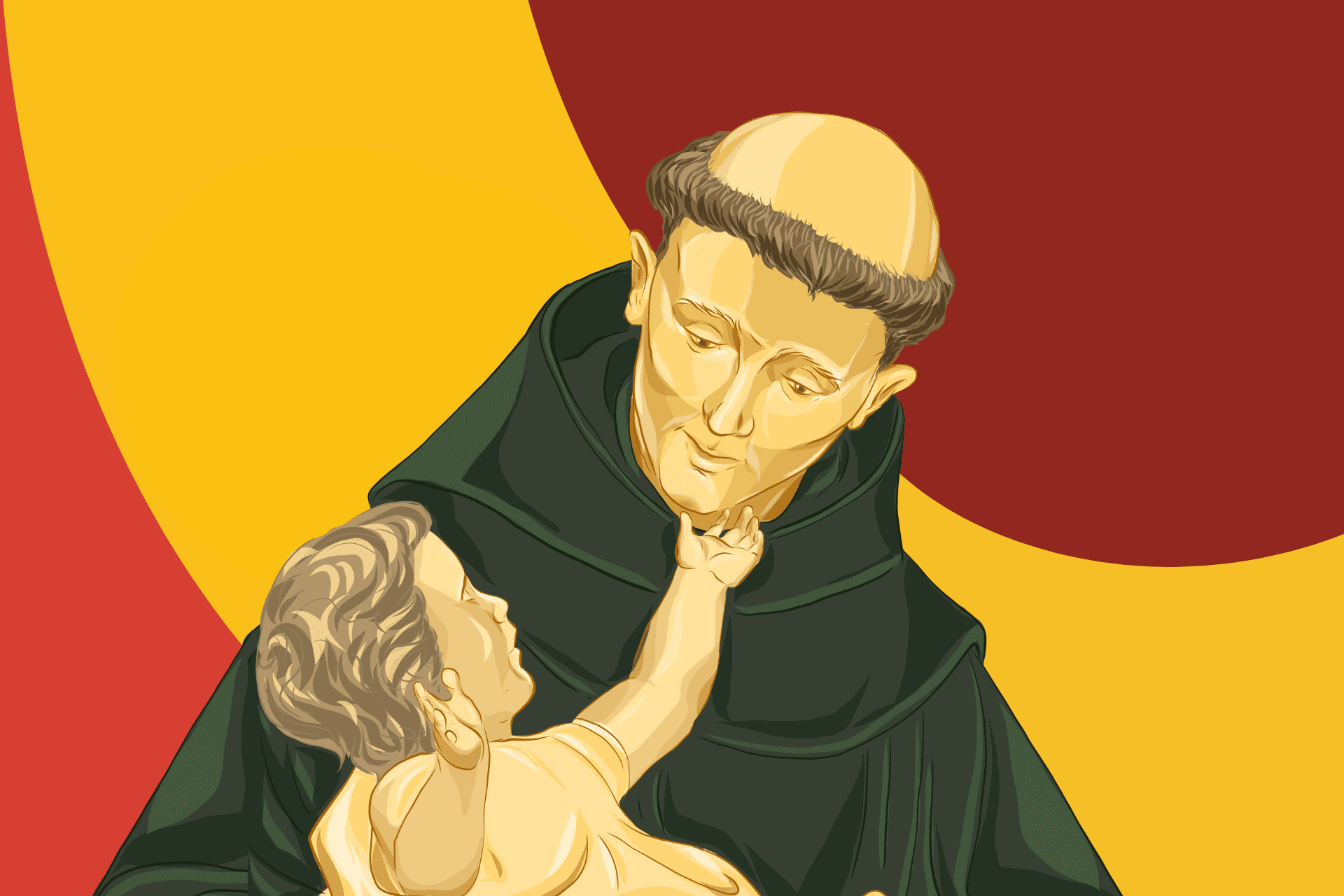
Today, 13 June, we celebrate the day of Saint Anthony, one of Patrons of World Youth Day (WYD) Lisbon 2023, chosen for having dedicated his entire life to Jesus Christ and to preaching. To get to know him better we leave here ten curiosities about his life:
1
Baptized with the name Fernando de Bulhões, Saint Anthony was born on August 15, 1195, in Rua das Pedras Negras, next to the Cathedral of Lisbon. It is in this place that today we can visit the Church of Saint Anthony, where a relic is found.
2
St. Anthony began his theological studies in the Monastery of São Vincent de Fora, where he took the habit of Canon Regent of St. Augustine. He then continued his theological formation in the Monastery of Santa Cruz de Coimbra. It was the arrival of the relics of the Holy Martyrs of Morocco, in 1220, that led him to take the Franciscan habit and assume the name of António, after which he retired to the Hermitage of Santo Antão dos Olivais, where the Church of Santo António dos Olivais now stands.
3
In 1228 he attended the canonization of St. Francis, a year in which he also went to Ferrara, Bologna and Florence. The following year his preaching took him to Vareze, Brescia, Milan, Verona and Mantua, an activity to which he would dedicate himself exclusively. In 1231, after contacts with Gregory IX, he returned to Padua, and the following year Lent was marked by a series of sermons of his own. Already ill, he died on June 13 of that year.
4
He was canonized on May 30 of the following year. When his tomb was opened to begin the process of transferring the remains, his tongue was found incorrupt. St Bonaventure was present and said that this miracle was proof that St. Anthony's preaching was inspired by God. In his canonization process, 53 accounts of miracles attributed to St Anthony were considered.
5
Art and artistic creation were always a constant in the life of St. Anthony and, after his death, he inspired many artists, and many of these works are currently on display in churches and museums. His image was also used on the old 20 escudo notes, the Portuguese currency which preceded the euro.
6
On January 16, 1946 Pope Pius XII proclaimed him "Doctor of the Universal Church" with the title Doctor Evangelicus. Although the effects of his preaching cannot be recovered, his style and the contents he dealt with can be partly recognised through the 77 sermons which have come down to us and are included in the work Sermões Dominicais e Festivos (Sunday and Festive Sermons).
7
The cult of Saint Anthony does not reside only in the Basilica that was erected in Padua after his canonization. In Portugal there are several temples built in his honour, where in the 13th century he was already patron of about forty churches spread all over the country.
8
By the 16th century the Portuguese had already fully adopted him as the main "National Saint", as protector of the city, of the houses and families, advocate of the souls in purgatory, advocate of good marriages, protector of animals, maker of miracles, advocate of lost objects, helper of those who fight, healer of the sick, protector of the shipwrecked and the one who frees men from demonic temptations, finding the toponymy all over the country filled with his name.
9
Following the earthquake in Lisbon in 1755, a collection was made to rebuild the partially destroyed Church of Santo António. From then on, the Castle and Alfama began to celebrate St. Anthony during the month of June, festivities called Santos Populares (Popular Saints), which also integrate St. John and St. Peter.
10
On the occasion of his visit to Portugal in 1982, Pope John Paul II entered the Church of Saint Anthony and descended into the crypt to pray, having then inaugurated the statue of Saint Anthony that stands outside and on whose base are the elements of the miracles performed by him. Inaugurated in 2014, next to his church is the Museum of Santo António, resulting from the reformulation of the previous Antoniano Museum created in 1962, where you can learn about the life of the Saint and his relationship with the city of Lisbon.